Which perennials and shrubs will survive in your yard?
Flower Bed Sketch measures the sun in your yard with the camera, your hardiness zone from thirty years of climate records and your soil in three questions, then tells you which plants will make it, with the reasons.
Free for two spotsiPhone and AndroidEnglish and French
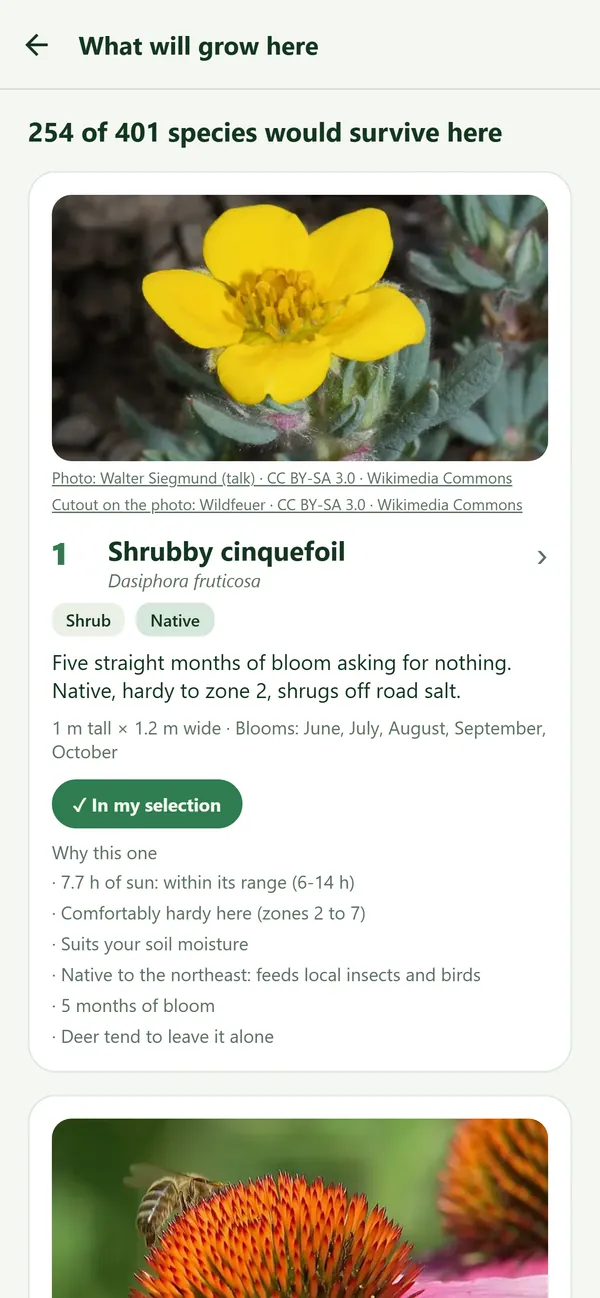
The app in pictures
From measured sunlight to the care calendar
What the app does
Measurements, not an invented picture
Every number comes from a public source and every suggested plant comes with its reasons. What was ruled out is counted, and you’re told why.
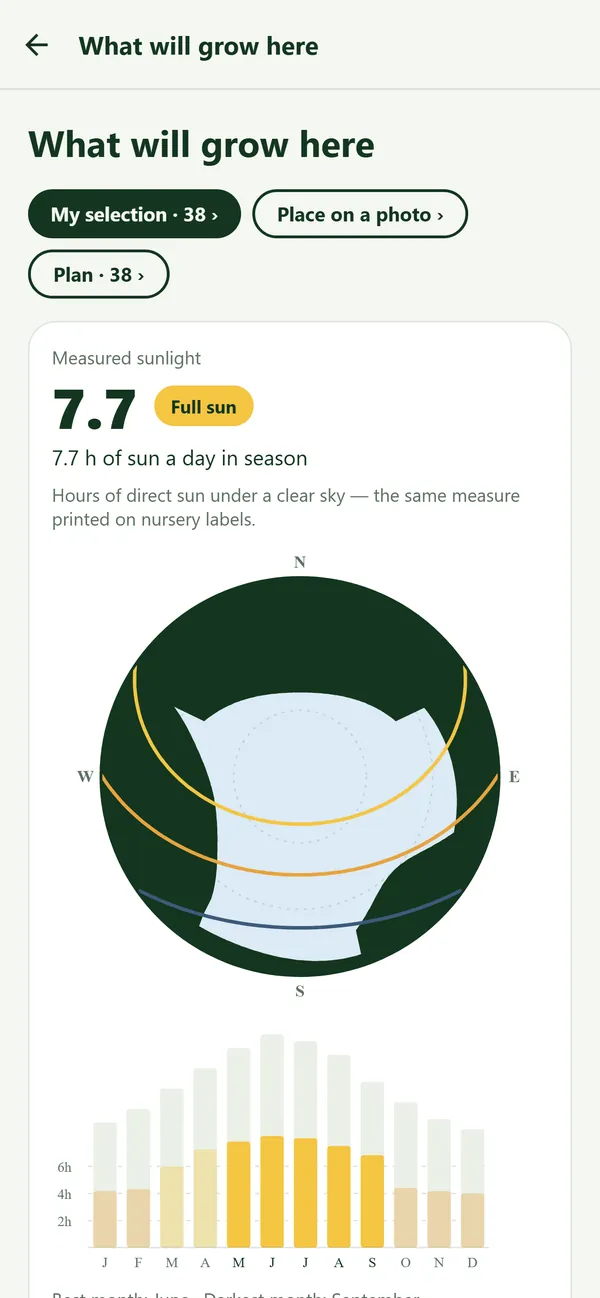
Sunlight, measured on the spot
Turn in a circle with the camera: the app records the roofs and trees, then calculates the hours of direct sun month by month, the same measure as on nursery labels. The same day, it tells you what time the sun will reach the spot, so you can check it with your own eyes.
Your zone, calculated and explained
Thirty years of climate records at your location: for example, “your winters drop to −27 °C on average,” the record low, the frost dates, the growing season. In Canada, the Canadian zone printed on nursery tags is shown too; the two systems can’t be converted into each other.
Plants that will last, with the reasons
Three questions about your soil, four about your constraints: deer, road salt, black walnut, children and pets. Four hundred nursery species screened: the ones that survive, why, and the count of those ruled out. Invasive species are flagged, toxic ones filtered out.
To scale, for real
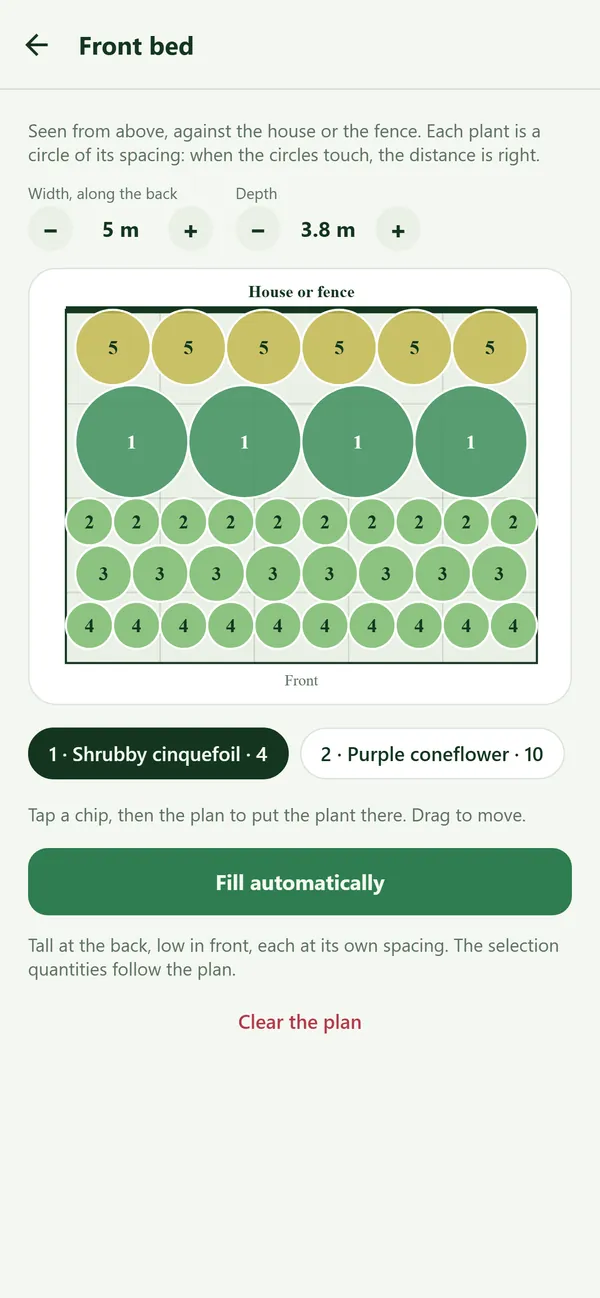
Every plant at three years and at maturity, next to a person. Place it on a photo of your flower bed: it’s drawn at its true size, as seen from where you stand. Draw the plan from above: each plant is a circle of its spacing, and “Fill automatically” puts the tall plants at the back and the low ones in front.
The list for the nursery
Quantities, center-to-center spacing, bloom across the whole selection month by month, with the gap named: “nothing blooms in August.” PDF export with the plan, to take with you down the nursery aisle.
The first year, at the right time
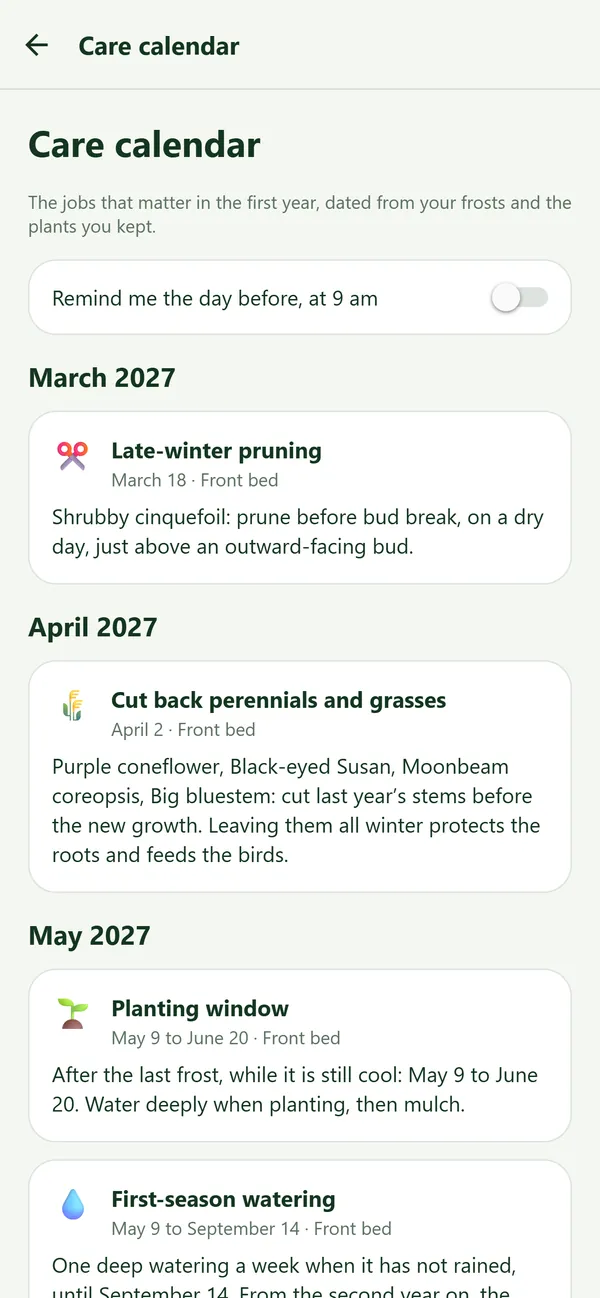
Planting after the last frost, watering through the first season, pruning right after bloom for what flowers on last year’s wood, protection before the first frost for what is only just hardy: everything is dated from your frosts, with reminders on your device.
How it works
Three steps, a list that holds up
No account. Thirty seconds if you declare the exposure, five minutes outside if you measure it, and you can always measure later.
Your location
The app downloads thirty years of climate data for your location and works out your zone, your frost dates and your growing season.
Your spot
Scan the horizon from the spot you want to plant, or declare the exposure for now. Three questions about the soil, four about the constraints.
Your plants
The list, each species with its reasons. Keep the ones you want, place them on the photo and the plan, export the list, and let the calendar remind you of what comes next.
Everywhere, starting with Quebec
Public data, every source named
Nothing is made up. Climate from Copernicus, observations from GBIF, plant data from the USDA, zones from Natural Resources Canada, text from Wikipedia and photos from Wikimedia Commons: each one is credited in the app.
Both hemispheres
Sun, zone and frost dates are calculated anywhere on the planet, in Montreal as in Canberra. The catalog covers northeastern North America first; other regions will follow.
Canadian zones
Nursery tags in Canada carry the Canadian zone, not the USDA zone. The app shows both, and tells you why they can’t be converted.
Observed near you
Species already recorded within 20 km of your yard, according to GBIF’s public observations, move up the list.
Data: climate Open-Meteo (ERA5, Copernicus, CC BY 4.0) · observations GBIF · species characteristics: USDA PLANTS · names: Wikidata · descriptions: Wikipedia (CC BY-SA) · photos: Wikimedia Commons (credited on each plant sheet) · Canadian hardiness zones: Natural Resources Canada (Open Government Licence – Canada) · sun position: NOAA algorithm.
Free and subscription
What will grow in your yard stays free
Pro adds the tools to make it happen.
Free
For two spots, with no time limit
- The sun scan and the declared exposure
- The calculated hardiness zone and the frost dates
- The full results, with their reasons and the species ruled out
- The plant sheets, the selection and its quantities
- The bloom calendar and the care calendar
Flower Bed Sketch Pro
The tools to make it happen
- Unlimited spots
- Plants at their true size on your photo
- The flower bed plan, filled automatically
- The shopping list as a PDF for the nursery
- Care calendar reminders
Yearly or monthly subscription. Renews automatically unless canceled at least 24 hours before the end of the current period, in your account settings. See the price on the App Store or Google Play. Terms · Privacy policy
Frequently asked questions
What people ask us
How do I find out how many hours of sun a spot in my yard gets?
Stand where you want to plant and turn in a circle with the camera: Flower Bed Sketch records the roofs and trees that block the sky, then calculates the hours of direct sun month by month across the whole growing season, like on a nursery label. No time? Declare the exposure (full sun, part shade, shade) and measure later, without losing anything.
How do I find my hardiness zone?
The app calculates it from thirty years of climate records at your location and explains it: the average minimum temperature of your winters, the record low, the frost dates. In Canada, it also shows the Natural Resources Canada zone, the one printed on nursery tags; the two systems can’t be converted into each other.
What plants should I choose for a shady spot?
It depends on the actual hours of sun, the soil and your constraints. Under two hours of direct sun, the app only suggests what does well in shade (ferns, hostas, heucheras, some shrubs) and tells you why each species was kept, and how many were ruled out.
Does the app work outside Quebec?
The calculations (sun, zone, frost dates) work anywhere on the planet, in both hemispheres. The plant catalog covers northeastern North America first (Quebec, Ontario, New England); other regions will follow.
Is Flower Bed Sketch free?
The scan, the zone, the results with their reasons, the plant sheets, the selection and the calendars are free, for two spots. Flower Bed Sketch Pro adds unlimited spots, the photo to scale, the flower bed plan, PDF export and reminders, with a yearly or monthly subscription at the price shown on the App Store and Google Play.
Are my photos sent anywhere?
No. Your photos, scans, plans and lists stay on your device. Only your coordinates, rounded, are sent to the public services that provide the climate, the species observations and the Canadian zone.
In the same family
Trust
Privacy first
Privacy
No account, no ads, no trackers. Your photos, your scans and your lists stay on your phone; only your coordinates, rounded, are used to download the public data. Reminders are local notifications, with no server.
Terms
The subscription is optional and can be canceled in your App Store or Google Play account settings.
You won’t lose your next shrub
Scan your yard, read your zone, choose what will last. Free for two spots.